
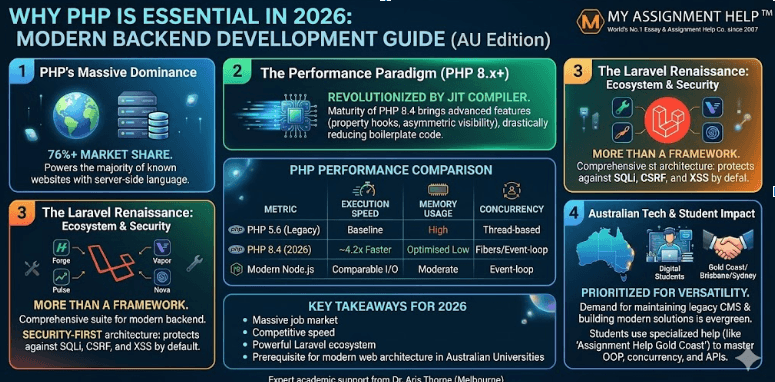
The narrative surrounding backend development in 2026 is often dominated by the rapid rise of AI-integrated languages and serverless architectures. However, for those working in the trenches of full-stack engineering, one name remains surprisingly constant: PHP. Despite decades of “imminent demise” predictions, PHP (Hypertext Preprocessor) powers over 76% of all websites with a known server-side language. In 2026, it isn’t just surviving; it is thriving through a renaissance of performance, tooling, and architectural elegance.
In the high-pressure environment of Australian tertiary education, particularly in technology hubs across Queensland, students are increasingly required to master these complex backend ecosystems. Navigating the shift from basic scripting to advanced OOP (Object-Oriented Programming) can be daunting. Consequently, many students seeking to maintain their competitive edge are looking for reliable assignment help gold coast services. This localized support allows aspiring developers in Australia to balance their rigorous curriculum with the practical application of modern PHP frameworks, ensuring they are industry-ready upon graduation.
The Performance Paradigm: PHP 8.x and Beyond
The PHP of 2026 is a far cry from the sluggish versions of the early 2000s. The introduction and subsequent refinement of the Just-In-Time (JIT) compiler in PHP 8.0 marked the beginning of a performance era that rivals compiled languages for specific use cases. In 2026, the maturity of PHP 8.4 has brought advanced features such as property hooks and asymmetric visibility, significantly reducing boilerplate code and enhancing the developer experience (DX).
Modern backend development is increasingly about handling concurrent requests and real-time data streams. PHP has stepped up with “Fibers” and integration with high-performance servers like RoadRunner and Swoole. This allows PHP applications to handle thousands of concurrent connections, a feat previously reserved for Node.js or Go. For students struggling to grasp these advanced concurrency models, seeking specialized PHP Assignment Help is a common way to bridge the gap between theoretical knowledge and professional-grade implementation.
| Metric | PHP 5.6 (Legacy) | PHP 8.4 (2026) | Modern Node.js |
| Execution Speed | Baseline (1.0x) | Approx. 4.2x Faster | Comparable in I/O |
| Memory Usage | High | Optimised (Low) | Moderate |
| Concurrency | Thread-based | Fibers/Event-loop | Event-loop |
The Laravel Renaissance: Frameworks as Ecosystems
In 2026, PHP’s relevance is inextricably linked to the dominance of Laravel. No longer just a framework, Laravel has evolved into a comprehensive suite of tools (Forge, Vapor, Pulse, and Nova) that manage everything from serverless deployment to real-time monitoring. For a senior backend developer, Laravel provides a “batteries-included” approach that drastically reduces Time-to-Market (TTM).
The Australian market, specifically digital agencies in Brisbane and Sydney, relies heavily on Laravel for rapid application development. It offers a security-first architecture that handles SQL injection, cross-site request forgery (CSRF), and cross-site scripting (XSS) by default—critical features for maintaining high academic and professional standards in code quality.
Key Takeaways for 2026 Developers
- Ubiquity: 76%+ market share ensures a massive job market for PHP specialists.
- Speed: Modern JIT compilers make PHP competitive for high-performance CPU tasks.
- Ecosystem: Laravel remains the most popular backend framework globally for developer happiness.
- Education: Mastery of PHP is a prerequisite for understanding modern web architecture in Australian universities.
Why PHP Remains a Core Skill for Australian Students
Australia’s tech industry prioritizes versatile developers who can maintain legacy systems while building modern, scalable solutions. Because the majority of the world’s CMS (Content Management Systems) like WordPress and Drupal run on PHP, the demand for developers who can extend these platforms is evergreen. For an Australian student, learning PHP isn’t just about learning a language; it’s about gaining entry into a massive economy of maintenance and innovation.
See also: How Crypto ATMs Work
Frequently Asked Questions
1. Is PHP still worth learning in 2026?
Yes. With its massive market share, modern performance upgrades, and the powerful Laravel ecosystem, PHP offers one of the best ROIs for developers in the Australian job market.
2. How does PHP handle modern security threats?
Modern PHP frameworks include built-in protection against the most common web vulnerabilities like SQLi and XSS. However, developers must still follow best practices for data sanitization.
3. Where can I get help with complex PHP coding projects?
Students can access expert academic support for complex topics like database normalization and API integration through dedicated technical writing services.
Author Biography
Dr. Aris Thorne is a Senior Academic Writer and Full-Stack Consultant at MyAssignmentHelp. With over 15 years of experience in software engineering and technical education, Dr. Thorne specializes in assisting Australian students through the complexities of modern web development. Based in Melbourne, he focuses on the intersection of PHP architectures and AI-driven automation.
References:
- W3Techs (2026): Usage statistics of server-side programming languages.
- JetBrains Developer Survey (2025): State of the PHP Ecosystem.
- Laravel Documentation (2026): Performance and Scalability Benchmarks.
- Australian Bureau of Statistics (2025): Tech industry employment trends.
